
46% of consumers now trust AI more than a friend when making subjective shopping decisions.” (Bloomreach, 2025)
The Myth of Infinite Choice
For decades, the foundational logic of marketing was simple: more is better. Give the consumer more variety, more shelf space, and more customisation, and they will reward you with their loyalty.
This is now a fallacy.
When a modern shopper attempts to buy a seemingly simple product—a laptop, a prebiotic soda, a moisturiser—they are confronted with a digital environment containing millions of SKUs, thousands of conflicting reviews, and an endless array of sponsored ads. Not even online forums, like Reddit, which used to be a safe-haven for unbiased opinion, are safe from bots and ads these days
Rather than feeling empowered, the human brain short-circuits. Recent data from Attentive (2026) reveals that 70% of online shoppers report feeling overwhelmed by options, leading a staggering 21% to abandon their carts completely .
Humans are wired to conserve mental energy. When the cognitive friction of comparing 50 different variations of a product outweighs the perceived reward of the purchase, the brain exits.
Enter the AI shopping agent. The motivation driving the mass adoption of AI in commerce is not the pursuit of a “better” product. It is the urgent need for Cognitive Offloading – the outsourcing of mental effort to a machine.
Algorithmic Appreciation
To understand this behavioural shift, we must look at how our psychological relationship with technology is rewiring.
Historically, we didn’t trust machines to understand human nuance. But as choice overload has reached a breaking point, we have swung in the opposite direction.
According to 2025 research from Bloomreach, nearly 60% of consumers now actively use AI to help them shop. Why? Because consumers now view algorithms as hyper-rational and immune to the fatigue of human decision-making.
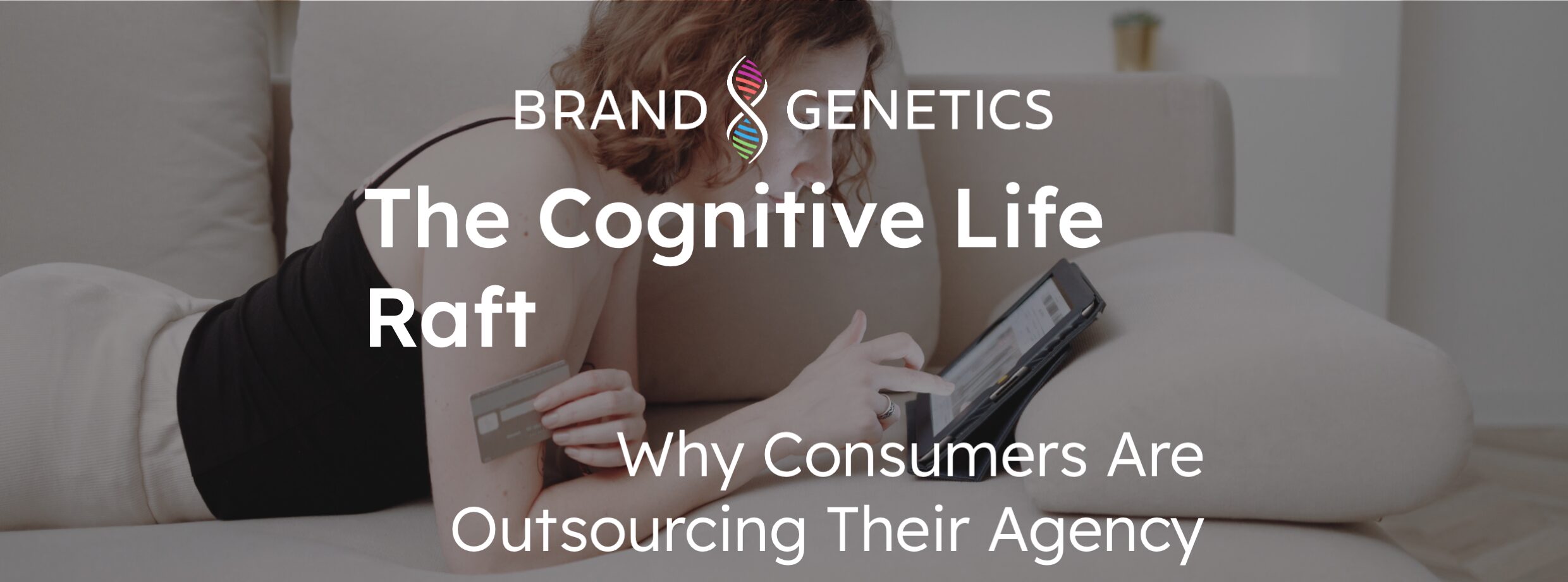
The consumer’s “job to be done” has changed. They are no longer hiring a tool to help them find a product; they want the algorithm to act as a cognitive life raft, rescuing them from the sea of infinite options.
Trusting in Trust
For brands trying to navigate this new delegated search landscape, it is important to understand how AI is choosing what to recommend.
A recent publication by Computer Science researchers out of Yale and Columbia suggests ratings and reviews have a significant impact on the way AI agents recommend products to consumers. Trustpilot found that a company’s likelihood of showing up in AI search increases from 1% to 75% if they maintain an active profile on these types of review sites.
Whilst AI excels at matching products to a list of criteria, it defers to trusting real human experiences when choosing between them. The algoritihim is trusting in trust.
So What? Choose Your Battlefield
The consumer’s motivation has fundamentally shifted from seeking Information to seeking Instruction. To unlock brand growth in an era of delegated decisions, you must align with the psychology of Cognitive Offloading:
1. Reduce the Cognitive Tax: Stop making your consumers think. If your product portfolio is too complex to navigate, you will be abandoned for a simpler alternative. Use consumer facing language highlighting benefits rather than features or ingredients. Emergent VMS giants suchs as Olly have found major success with this, directing consumers towards “sleep” products rather than “melatonin.”
2. Optimise for the Delegate: The consumer is no longer your only audience. You must structure the way your brand shows up online in a way that an AI agent can instantly recognise your product as the most logical, frictionless solution.
3. Invest in meaningful reviews: By proactively managing your “digital integrity” on review platforms, you provide the machine with the third-party proof it needs to confidently delegate its choice to you.
Let Brand Genetics help you uncover the goals your consumer is hiring your brand for and become the cognitive life raft they are so desperately searching for.
This article decoded the Drivers (Motivation) of AI-led choice, exploring why the modern human brain is actively seeking to outsource its agency. But motivation alone doesn’t change behaviour. To see the full picture, explore how the digital environment is shifting in eNablers, and the new psychological skills consumers are mastering in Abilities.