
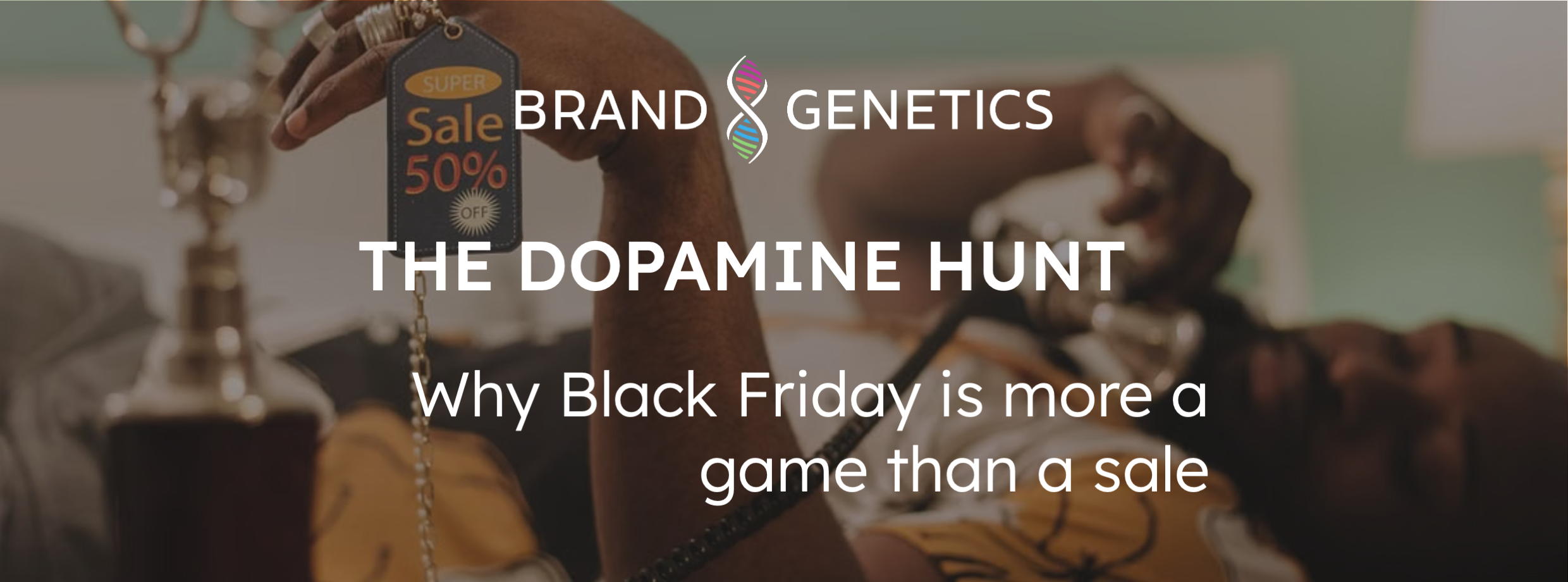
Every November, the retail and consumer goods industry descends into a familiar commercial spiral. Marketing budgets are driven into digital ad auctions, promotional banners turn an aggressive shade of crimson, and margins are sacrificed: 30% off, 40% off, 50% off everything
The underlying economic assumption is simple: if you make a product cheaper, price elasticity dictates that demand will surge; but that logic is broken.
As we navigate peak promotional season, behavioural science reveals a far more disruptive reality. Consumers flood shopping apps and retail aisles for the thrill of the hunt.
Against this backdrop, Black Friday has become so much more than a financial calculation. Today it is an adrenaline-fuelled, high-stakes psychological sport, and the discount has moved from being a highly coveted prize by itself to the scoreboard that records a persons yearly victories.
The Neurobiology of Anticipation
To understand why we have to look past economics and examine human neurobiology.
Popular culture treats dopamine as the molecule of pleasure. In neuroscience, it is something entirely different: it is the chemical of anticipation, motivation, and pursuit. Neurobiologist Robert Sapolsky demonstrated, dopamine neurons fire between the cue and the action – i.e. in the tense, uncertain window of the chase – rather than after the reward has been secured. Once an item is purchased and unboxed, dopamine levels plummet back to baseline.
Crucially, neuroscientist Wolfram Schultz discovered that when a reward is uncertain (a 50% chance of winning or finding an item in stock), dopamine output doubles compared to a guaranteed reward.
This is why blanket 20% markdowns feel so lifeless. When a discount is universally guaranteed, the uncertainty is eliminated, the chase evaporates and the purchase collapses into a cold, commodity transaction.
Decoding the 4 Game Mechanics of the Hunt
In gamification design, pioneer Yu-kai Chou created the Octalysis Framework, mapping human action across eight core behavioural drives [Yu-kai Chou: Octalysis Framework].
When we view Black Friday through this lens, it becomes obvious why consumers behave so irrationally. Discount season operates on four high-octane motivational engines:
- Development & Accomplishment (The Scoreboard)
Consumers aren’t motivated by savings alone, pairing this with a search for the feeling of personal competence. Nobel laureate Richard Thaler proved that purchase satisfaction is divided into 2 parts: Acquisition Utility (the physical value of the item) and Transaction Utility (the perceived merit of the deal itself). On Black Friday, the deal completely overpowers the item. Securing a £200 coat for £70 delivers an intoxicating narrative of mastery: the consumer feels they have outsmarted the retailer
- Scarcity & Impatience (The Drop Clock)
When an item is abundantly available, desire flatlines. By imposing artificial friction, such as limited stock allocations, hourly “shock drops,” and expiring cart reservations, retailers trigger urgency. The brain pivots from calculating value to seizing opportunity before a ‘rival’ claims it
- Unpredictability & Curiosity (The Digital Slot Machine)
Static discount catalogues trigger banner blindness. By introducing variable-ratio reinforcement, like flash sales that change on the hour, mystery vouchers, or unannounced bundle drops, platforms keep shoppers locked in a continuous loop of app refreshes and exploratory browsing
- Loss & Avoidance (The FOMO Trap)
Rooted in Daniel Kahneman and Amos Tversky’s Prospect Theory, humans are fundamentally loss-averse: the psychological pain of losing is twice as powerful as the pleasure of gaining. Countdown timers (“Offer expires in 00:14:23“) reframe inaction from saving money to an active financial loss
Don’t give away margin when you can sell the win
When brands fail to understand this psychological architecture, they default to blanket markdowns. The results can be devastating: compressed margins, brand devaluation, and an avalanche of post-purchase remorse (over 50% of Black Friday impulse buyers admit to regretting their purchases within weeks). [Guardian]
The most commercially sophisticated brands design an arena where the consumer feels the thrill of victory:
- Nike (Drop Mechanics vs. Price Cuts): Through its SNKRS platform, Nike rarely resorts to margin-destroying fire sales. Instead, they pioneered earned access: using digital queues, scavenger hunts, and lottery draws. The consumer feels like a champion who won access to an exclusive tier
- The Cautionary Tale of J.C. Penney: In 2012, former Apple executive Ron Johnson eliminated coupons and fake markdowns at J.C. Penney, replacing them with honest, everyday low prices (“Fair and Square”). The result was a $4 billion collapse in sales. By removing the inflated “was” price and the coupons, J.C. Penney stripped away the consumer’s Transaction Utility. Customers may not have known it but they wanted the emotional triumph of scoring a bargain
So What? The Brand Genetics Action Plan for Marketers
To win in peak promotional periods, brand leaders must be game masters:
- Banish the Blanket Markdown:
Universal percentage cuts destroy gross margin while delivering zero psychological engagement. Replace sitewide discounts with earned unlocks: spending-threshold progression bars (“Spend £15 more to unlock the VIP tier”), mystery gifts, or tiered rewards that lift Average Order Value
- Frame the Win, Supported by the Price:
Remember Richard Thaler’s equation: Transaction Utility is fuelled by the contrast between the reference price and the price paid. Move away from showing a low number and make sure to always frame the victory. Celebrate the magnitude of what the shopper conquered
- Balance Urgency with Pride:
If your entire sale relies on artificial countdown clocks and fear-driven scarcity, you create toxic post-purchase remorse. Anchor the promotional experience in accomplishment and status – make the customer feel clever, rewarded, and valued, ensuring holiday acquisition converts into long-term customer lifetime value
The Bottom Line
At Brand Genetics, our work centers on revealing the hidden human motivations that unlock genuine commercial growth.
Consumers aren’t waiting for Black Friday simply because they need more stuff; it’s much more interesting than that. It has become a cornerstone of the shopping calendar because of a near-universal anticipation for the thrill of the chase, the dopamine rush of the hunt, and the sweet satisfaction of outsmarting the system.
Give your customers a game worth winning.