
“Despite growing up in the streaming era, Gen Z consumers are now 27% more likely to purchase vinyl records than the average music listener, with sales hitting 47.9 million units last year.”
Luminate, 2025
The DNA of Growth: The Infinity Trap
We have made music libraries infinite.
We have made photography instant. We have made communication inescapable. We successfully optimised effort to zero. But in doing so, we accidentally optimised emotional value to zero too.
When a modern consumer – particularly a young consumer – navigates their day, they see a digital environment that is infinite, but it is also deeply isolating and mentally exhausting.
The human brain is not evolved to process infinity; it is evolved to navigate boundaries. When a consumer can listen to 100 million songs for £10 a month, the perceived value of any single song drops to zero.
This brings us to the phenomenon marketers dismissively call “Fauxstalgia.”
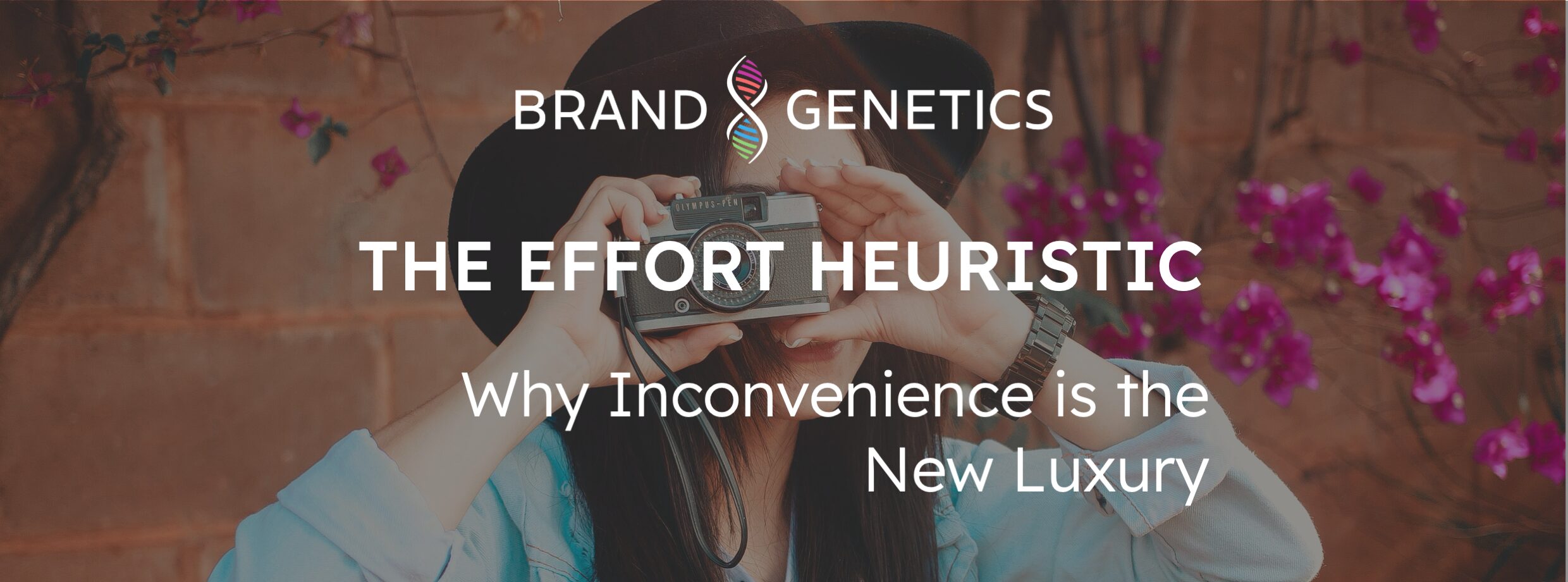
We see Gen Z consumers ravenously buying 1990s point-and-shoot digital cameras, spending millions on vinyl records, and trading in their iPhones for basic “dumbphones.” Marketers assume these consumers are just cosplaying an era they never lived through.
They aren’t.
They are actively hunting for the ‘Off Switch.’ The fundamental motivation driving this behaviour isn’t a desire for the past; it is the psychological demand for the finite.
The Driver (Motivation): The Effort Heuristic
To understand why young consumers are abandoning hyper-convenience, and chasing the nostalgic, we must look at a cognitive bias known as the Effort Heuristic (or the IKEA Effect).
Human beings are wired to assign greater value, quality, and emotional weight to outcomes that require effort, time, and friction to achieve.
When you strip all the friction out of a process, you strip the reward.
Taking a photo on an iPhone 16 requires zero effort; the AI processes the image perfectly in milliseconds, and it is instantly buried in a camera roll of 40,000 identical shots. But buying a vintage digital camera requires effort:
- You have to carry a separate device
- You are limited by a small memory card
- You have to wait until you get home to offload the SD card to see how the photos turned out
That friction – the wait, the limitation, the physical process – doesn’t make the photo worse. In fact, psychologically, it makes the photo valuable.
It’s not just that the consumer is buying a retro aesthetic, it runs much deeper than that. They are buying a sense of agency and presence that a smartphone cannot provide; they are paying a Friction Premium.
Bringing it to Life: The Return of Positive Friction
This demand for the finite is rewiring categories far beyond vintage technology. When consumers feel out of control, they seek out products that offer tactile, bounded, and deliberate experiences.
Look at the Music Industry. Why did vinyl sales cross 47 million units last year, driven predominantly by Gen Z? Because vinyl is fundamentally inconvenient. You cannot skip tracks easily. You have to physically flip the record after 22 minutes. That physical friction forces the consumer to actively listen rather than passively consume, making the limitation is the selling point.
Look at Telecommunications. Driven by digital fatigue, sales of basic feature phones (so called “dumbphones”) have surged. Brands like HMD (Nokia) and The Light Phone have seen massive growth because they offer a product that explicitly refuses to do everything. By offering a finite utility – just calls and text – they provide psychological relief from the infinite scroll.
We even see this in FMCG and Beverage. Consider the enduring brilliance of Guinness. In a category obsessed with instant refreshment, Guinness built its entire brand around the “119.5-second pour.” They turned a functional delay into a ritual of positive friction. You have to wait for it. Because you wait for it, your brain decides it must be worth waiting for.
So What? Choose Your Battlefield
If your brand strategy is entirely focused on making your product faster, easier, and more invisible, you are racing toward commoditisation.
Viewing all friction as a failure is fast become antiquated. Instead, we can start to leverage it as a tool for value creation.
1. Design Mindful Hurdles: Where can you re-introduce tactile steps into your customer journey? Give the consumer a physical or deliberate action to perform. Make them earn the outcome.
2. Embrace the Finite: Instead of promising consumers “endless options” provide curation, boundaries, and clear endings. A product that finishes has a higher perceived value than a service that never stops.
3. Show Your Work: The Effort Heuristic works both ways. If your product takes time, craft, or slow processes to create, don’t hide it. Make that effort visible.
Fauxstalgia is a fancy marketing label and manifestation of something consumers deeply need – to feel something real in the present. Give your consumers a reason to slow down, and they will reward you with their loyalty.
This article decoded the Drivers (Motivation) underpinning ‘Fauxstalgia,’ exploring why the modern human brain is actively seeking to outsource its agency. Check out this month’s full Newsletter here and understand the eNablers and Abilities that are driving this behaviour.