Decoding the DNA of Hinge’s ‘No Ordinary Love’: Swiping right to the power of real stories
This article is part of our series on DNA of Campaigns. You can view the full series or download the report.
People love love – or at least, we’re told we should. It’s everywhere: in our feeds, in our films, and inevitably in the questions from relatives (anyone looking forward to dinners with the extended family this holiday?). We’re promised that technology will help us connect more easily than ever before. But for Gen Z, the reality looks very different.
Over the past few years, young adults have shown less interest in dating and are spending far less on it than previous generations. And the very platforms designed to help them meet people aren’t inspiring any love stories either. Dating apps – once hailed as the frictionless path to your happily-ever-after – are now synonymous with fatigue. With 90% of Gen Z daters reportedly frustrated by endless swiping (Financial Times), and 80% of US college students foregoing them altogether (Wired), dissatisfaction has never been higher. All this, and the dating app marketing is still expected to go from $8.5B to $17B in the next five years. The gap between market projection and young user’s sentiment has never been wider.
Which brings us to Hinge – the star of today’s instalment of our Decoding the DNA of… series. Our Insights, Innovation & Strategy Consultant Karam Hansen uses the DNA model to explore how Hinge positions itself as the antidote to ‘swipe culture’ – tapping into daters’ desire for a slower, more intentional, more human connection in a world overwhelmed by fast-paced, profit-driven intentions.
Swipe right for something real
Hinge has long been a trendsetter in the dating app world. Since its launch in 2013, it positioned itself not as a place for casual encounters but as the relationship app. And in 2019, it leaned all the way in with its deliciously paradoxical ‘Designed to be deleted’ campaign, promising users they’d only need the app long enough to leave it behind. Glowing mentions from The New York Times and nods from public figures such as Pete Buttigieg meant Hinge was a breath of fresh air in the dating app market – the one you bring home to meet your parents.
Its ethos came to life again in August 2024 with the launch of ‘No Ordinary Love’, “an anthology of love stories that encourages daters to challenge the notion of ‘perfect fairytale beginnings’ and celebrate the beautiful imperfections of real relationships.”
Tapping into the meteoric rise of ‘BookTok’, particularly its romance-obsessed corner, Hinge paired six contemporary writers with real couples who met on the app, creating exactly what the audience ordered: authentic romance. The result was an 80-page zine created in collaboration with Dazed Studio, accompanied by OOH placements across London, Los Angeles, New York, and Sydney – reminding passers-by that love is still worth rooting for.
And, boy, did people root for it! Hinge reported a 10.5% jump in brand consideration in the US, with impressions beating industry norms by 44%. As any good romance franchise would, the brand returned for a second instalment in May 2025, this time partnering with well-loved Substack writers to tell a new wave of modern love stories – later compiled into a collectible, Jane Austen-coded book fit for the romantic’s nightstand.
By recognising how its own technology had helped create the very emotional fatigue its audience was feeling, Hinge was able to distance itself from the transactional ‘swipe culture’ and reframe its purpose around meaningful human connections. Not by shouting louder, but by shifting mediums, telling richer stories, and meeting its audience where their romantic imaginations already live.
Cracking the code for modern love
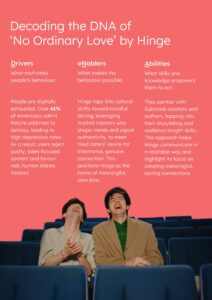
To read beyond the pages of Hinge’s fairytale success, we use our proprietary DNA analysis model to dive into their strategy – looking into what drives behaviour, and how brands can get out-of-the-box positioning in their categories.
The human behind the swipe
With 61% of Americans admitting to being addicted to their devices, and heavy internet users 2.5 times more likely to experience depression, it’s clear that attention-grabbing social media content, often selling something, is taking a toll. People are fatigued and yearning for genuine, human connections. Rather than ignoring this digital burnout, Hinge taps into users’ desire to be seen as full, flawed, fascinating humans with stories to tell. This is the key Driver behind the app’s positioning and campaigns.
Hinge understands that romance is a story – thriving on authenticity, individuality, and a sprinkle of mystique. And “we both swiped right” doesn’t capture any of these. The ‘No Ordinary Love’ campaign transforms algorithmic encounters into richer, more meaningful “how we met” stories – reassuring daters that swoon-worthy romance is possible, even in the sometimes-awkward world of online dating. By understanding and reflecting users’ desires, Hinge positions itself as an app that’s culturally relevant and genuinely seeks to improve people’s lives, not just sell a service.
When cultural shift met courtship
And while consumers may be motivated to seek something deeper, Hinge’s campaign and positioning wouldn’t land without the right eNablers. Today’s daters are tired – tired of being endlessly plugged in, of feeling boxed by a profile, and of the slow erosion of identity in a feed-driven world. Time, energy, and attention have become a new kind of social currency. In response, 96% of Gen Z now claim to shop with intention, and more than 70% research a brand’s ethics before buying (MSN). That mindset extends naturally to the apps they allow into their lives.
Hinge recognised this cultural shift and met people exactly where they already were, with what they wanted. Authentic online romance stories mean Hinge speaks to people on a more personal, intimate wavelength. But why lean on online creators at all? Because consumers trust them. Research shows people don’t just turn to creators for trends; 60% trust them more than traditional advertising (Edelman, 2025). As a testament to the success of online creators, the global creator economy was valued at $250B and projected to nearly double by 2027 (Goldman Sachs).
The app aligns itself with this emerging mindful value system and positions itself as the home for discerning, serious daters looking for real romance – not just another fleeting swipe. In doing so, it firmly plants its flag in the ‘slow love’ movement, championing connection over velocity, story over spectacle.
Designing for slow love
Ultimately, with the ‘No Ordinary Love’ campaign, Hinge has found a fresh and imaginative way to re-articulate its long-held philosophy – doubling down on its ‘Designed to be Deleted’ promise. And it’s a philosophy rooted in the mechanics of the app itself. Hinge mandates small moments of personalised efforts by limiting daily likes, prompting considered profiles, and nudging users to comment on fun facts. In a world of surface-level visuals, it insists on a flash of personality – giving the campaign substance with a message backed by design. No surprise, then, that 80% of Hinge users say they’re looking for a serious relationship.
The decision to collaborate first with beloved contemporary authors and later with Substack wasn’t just artistic flair; it’s a strategic return to the spaces where long-form storytelling still breathes – connecting with ideas rather than pure visuals. This reiterates that the app is a means towards a real-world end. These are the Abilities that allow people to act on their motivations: a platform designed for intention, a campaign that speaks their language, and a brand that repeatedly encourages authentic moments rather than fleeting ones.
By nudging people towards story, reflection, and, ultimately, each other, Hinge demonstrates a mission that’s both consistent and evolving. With every campaign, it reinforces the idea that love doesn’t have to be fast or flashy to be compelling – aligning itself with a tribe of people tired of ‘swipe culture’. Showing that things in real life grow, deepen, and take shape over time – much like the brand itself.